Unsafe in The Country of Origin
This article was originally published in German by taz, online and in print

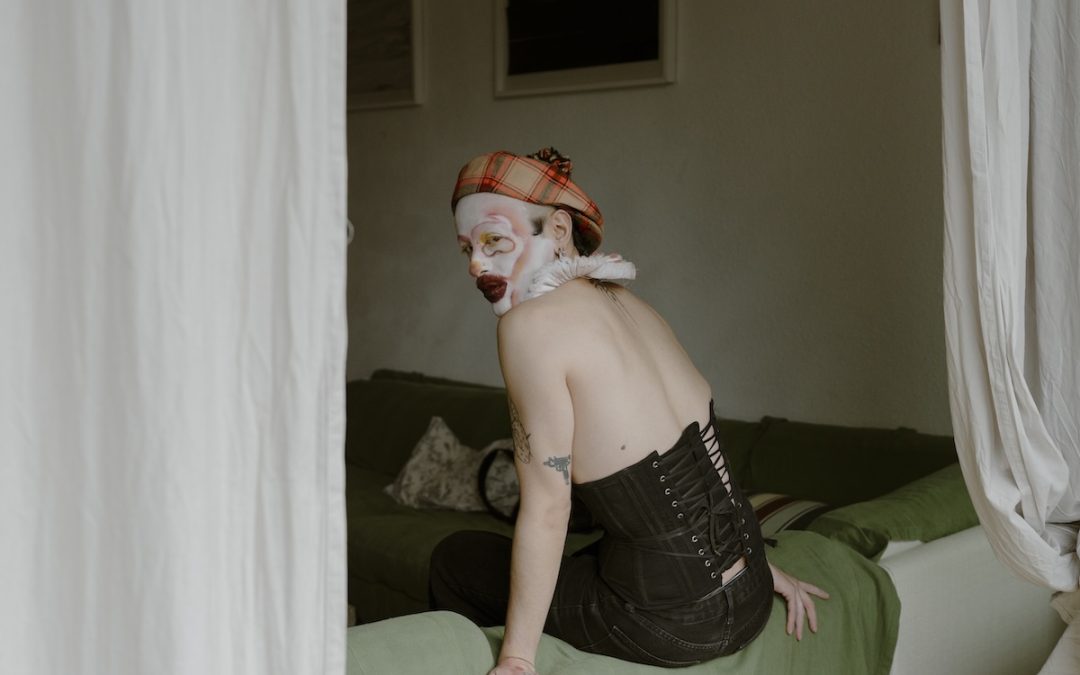
Fagatta poses for a portrait wearing her drag make-up, in the flat of Georgian friends.
Photo: Sitara Thalia Ambrosio
In the backyard of a club in Berlin’s Wedding district, Fagatta paints a clown face. White powder, black moustache, green eyeshadow. Eyeliner that reaches up to the eyebrows in curved zigzags, crowned with piercings at the tips. The drag show in which Fagatta is set to perform begins in an hour, but the wigs still hang uncombed above the doors and the performers crowd behind small mirrors leaning against beverage crates. Fagatta traces her eyeliner and talks about Pride in Tbilisi in 2023, when a right-wing mob stormed the festival grounds before the event began. It was a day like this, and Fagatta was getting ready for a performance. Looking back, it was the moment Fagatta realized that Georgia was no longer safe.
“They destroyed my makeup, my costumes,” says Fagatta, pointing to the brushes and fake eyelashes scattered on the counter, just like back then. “Everything I had collected over two years.” In the videos taken by journalists that day, one can see the attackers tearing up rainbow flags and setting fires. Fagatta recognized their own backpack in the evidence, a dress. “I’ve never experienced such hatred,” Fagatta says. “And at that moment, I was sure: if I had stayed there, I would have been injured or even killed.”
Fagatta fled and went into hiding. For days afterwards, Fagatta didn’t dare leave the house. The attack had intensified what Fagatta had already experienced before coming out as non-binary: the hostile looks, the verbal and physical attacks on the street, the feeling of being threatened. For a long time, Fagatta countered this fear with the hope that the state would protect the queer minority in an emergency. But on that July day, the police hardly intervened, merely watching the devastation unfold.
It was the lack of security that drove Fagatta out of Georgia. It was drag that drew Fagatta to Berlin. The longing for a life that feels like it is truly one’s own. About three months after the attack, on October 15, 2023, Fagatta arrived in Germany. Another month later, the German government classified Georgia as a safe country of origin – and the Federal Office for Migration and Refugees (BAMF) rejected Fagatta’s asylum application as “manifestly unfounded.” Fagatta appealed the decision but has not yet received a response from the court. “My biggest fear is that I will have to go back to Georgia, that I will be deported,” says Fagatta, blackening their already dark mustache.
Then the show begins. Fagatta squeezes into a corset, slips into high-heeled pumps with straps, and combs the blonde wig one last time. They grab a miniature handbag and tuck a homemade voodoo doll into the breast pocket of their blazer. Accompanied by Lady Gaga’s “Donatella” and the cheers of the crowd, Fagatta takes the stage.
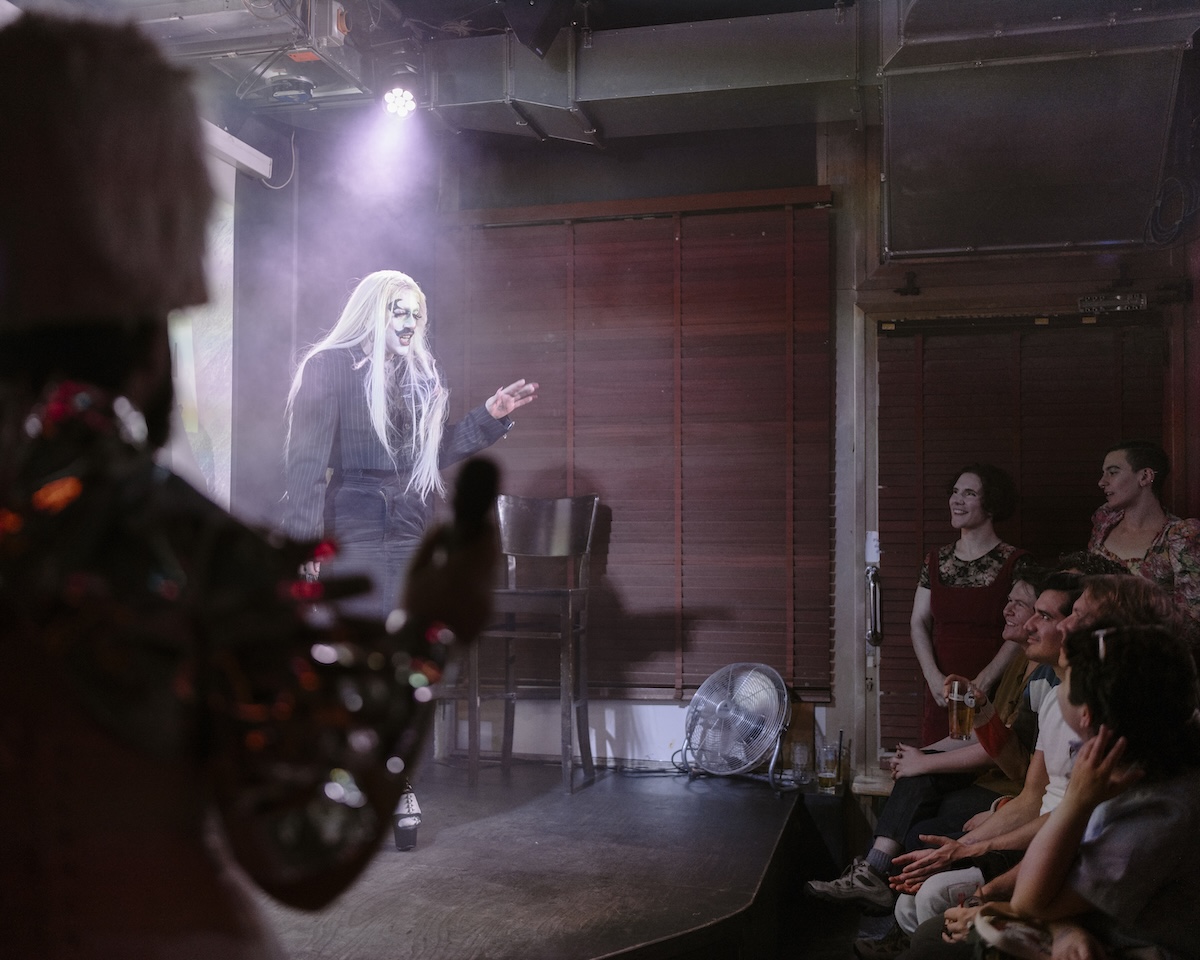
Fagatta presents a drag performance at the LGBTQIA+ bar ‘Tipsy Bear’ in Prenzlauer Berg, Berlin. The event series, called ‘QAUCASIA’, aims to contribute to the visibility and joy of the queer community from the South Caucasus and Central Asia. Photo: Sitara Thalia Ambrosio
Even before Georgia was classified as a safe country of origin, the protection rate for Georgian asylum seekers was only 0.3 percent. But the new law – a piece of the puzzle in the migration agreement that the two countries agreed upon in December 2023 – further increased the hurdles. People like Fagatta must provide “credible and concrete” evidence that they are being persecuted because of their gender identity or sexual orientation. According to its own information, the BAMF does not record how often this is actually successful, nor does it record the reasons why people seek asylum.
However, the asylum statistics show that the chances of protection are negligible: in 2024, 2.635 Georgians applied for asylum for the first time. One person was recognized as a refugee, and three others were granted subsidiary protection. In the same year, Germany deported 1.600 Georgians – more than any other country. And the rights of those seeking protection have also been restricted since then: Fagatta had only one week instead of two to file a lawsuit against the BAMF’s decision, does not have a work permit and is not allowed to leave Germany. Waiting for life to begin here.
Adora walks alongside her friend Nia along the Landwehr Canal in Kreuzberg. Both are wearing heavy black platform boots, which set a steady rhythm. “It’s particularly bad in the suburbs of Tbilisi,” Adora says. “You have to hide there.” – “I hid in the city center too,” replies Nia. “When I went shopping, I took off my makeup and my wig so that no one would know who I was.
They attacked me on the subway: ‘You’re a man, act like one.’ After that, I never rode it again.”
Adora nods. No trans woman has to explain to another why she doesn’t ride the subway in Georgia. But here, her reality has been frayed into a bundle of arguments—as if every listener were allowed to decide whether she has the right to stay. They sit side by side on a bench by the shore, smoking and looking out at the water. Adora has crossed her legs, her curls held back with clips. After a while, Nia says, “For Germany, Georgia is a safe country of origin – but they don’t know what’s going on there.” – “I think they do,” Adora replies.
Adora only decided to leave Georgia this March. She turned 22 in August – her first birthday away from home. Unlike Fagatta, Adora came knowing that Germany considers her country of origin to be safe. Nevertheless, she hoped that her case would be successful. That what she had to report would be enough to grant her protection. “It started with fear,” she says, her bleached eyebrows drawn together in concentration. She is referring to her life as a trans woman: domestic violence, a father with whom she still has no contact. A suburb where her classmates called her names before she even realized she was trans. Repeated physical assaults.
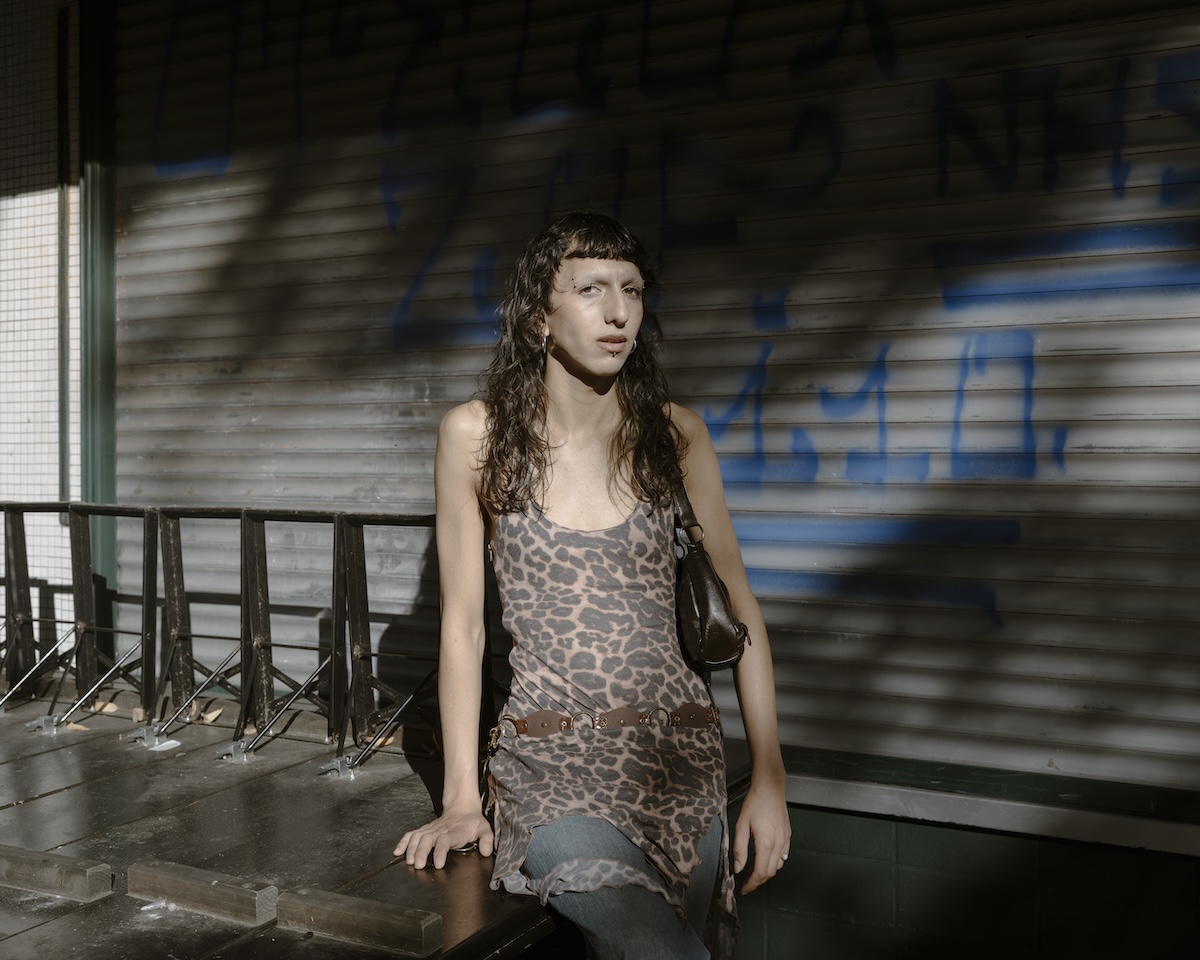
Portrait of Adora, who has only been in Germany for four months. At the age of 21, she decided to go into exile because it was becoming dangerous for her as a trans woman in her home country. However, her asylum application was rejected. She lives in a refugee shelter in Berlin – on her mother’s money. Photo: Sitara Thalia Ambrosio
At the age of 21, Adora moves to the city center to escape the violence. She comes out and begins her transition, at least as far as she can: she takes medication to lower her testosterone levels without medical supervision. The fear remains and grows. Because in September 2024, the Georgian parliament votes in favor of a bill proposed by the ruling Georgian Dream party: a law to “protect family values and minors” based on the Russian model, which allows authorities to refuse same-sex marriages, medical gender reassignment procedures, or the adoption of children by queer people. Pride events and the rainbow flag can be banned, and books and films about queerness can be censored. One day after the law is passed, Kesaria Abramidze, a well-known trans model and actress, is stabbed to death by her partner.
“I grew up with trans women being killed,” says Adora. Her friend Nia stares into space. Nia has been here for over three years, having fled after an armed group of men attacked her after a Pride event. Unlike Adora, she has no mother to support her financially; she earned the money for Germany as an escort. Her application was also rejected, she also appealed against the decision and is still waiting for a response. “How can we imagine a future in Georgia when we don’t see any trans women growing old?” asks Adora. It would be a secret life, a threatened one; one that takes place mainly on weekends, in bars and clubs. One that Adora does not want to limit herself to. “I don’t want to stay in my bubble,” she says. “I want to move freely, I want to ride the subway, I want to grow old.”
When mass protests began in Tbilisi in the fall of 2024, Adora was also on the streets, watching friends being violently arrested, to the point where she finally lost faith in the rule of law.
“I felt like we were going backwards,” she says. So she fled forward.
Adora stayed at an arrival center in Berlin-Reinickendorf for the first two weeks before moving. Now she lives in a room with three other trans women from different countries, the beds separated by fabric panels. She tries not to think too much about the court’s decision. She attends language classes, goes to parties, and meets her friends from Georgia who share her fate. “I’m still in survival mode,” Adora says. “I haven’t made it out yet.”
In recent years, several German administrative courts have ruled in favor of queer asylum seekers from Georgia. As early as 2020, the Berlin Administrative Court certified that the Georgian state had a “systematic protection problem” and was partially actively involved in thwarting queer rights. In 2022, the same court warned that applications should not be limited to physical assaults. “Violent assaults are only the most serious manifestations of a widespread homophobic and transphobic attitude,” the ruling states. The fact that an active queer scene has formed in Tbilisi does not mean that people are no longer exposed to inhuman and degrading treatment in their everyday lives.
In November 2024, a judge at the Meiningen Administrative Court expressed doubts about Georgia’s classification as a safe country of origin. In March 2025, the Berlin Administrative Court also raised doubts as to whether this classification was compatible with EU law – and in May added to the demand that queer people from Georgia be recognized as refugees due to persecution by the Georgian state and non-state actors.
Fagatta’s hope for asylum has grown since the passage of the anti-LGBTIQ law. “When I left Georgia, the situation was not much different than it is today,” says Fagatta. “But it wasn’t official.”
The law makes it clear to everyone that the state is trying to eradicate their existence. “That’s why I hope Germany will reconsider its decision.”
Fagatta has spread out a blanket in Charlottenburg Palace Park, near the accommodation where Fagatta has been living with their partner for just over a year. The drag makeup is gone, revealing a pale face with dark eyes. There is something vulnerable and restless in Fagatta’s gaze, framed by two strands of hair curling on their skin. Fagatta comes here almost every day. “I try to keep moving,” says Fagatta. Adora said the same thing as she walked along the Landwehr Canal. Keep moving, feel movement where nothing moves.
It took six months for Fagatta to receive the negative asylum decision. “At first, I coped well,” says Fagatta. “I never thought I had such strength in me.” But as the weeks of waiting dragged on, Fagatta felt worse and worse. “Every day begins with a question mark, the uncertainty is with you all the time.” For several months, Fagatta canceled all drag shows. Even though there is hardly anything more important.
The scenarios in Fagatta’s head keep revolving around the decision to move to Berlin. If they had gone to Brussels instead, they would already have a residence permit, be allowed to work, find their own apartment, and travel. Belgium removed Georgia from its list of safe countries of origin in 2023, partly because of the situation of queer people. The chances of asylum are better there. But as long as their case is pending in Germany, Fagatta cannot leave.
If Fagatta is granted asylum, they already have a plan: a B2 language course, then training as a costume designer. They will work part-time so they can continue performing as a drag artist. “I’d rather work than get money from the state,” says Fagatta. “I want to be independent.” Fagatta’s lawyer was optimistic during their last phone call. But Fagatta also knows stories like that of Adora, who fled after the anti-LGBTIQ law was passed – and still did not get asylum.
Adora brought the transcript of her hearing, which lasted several hours, as well as her decision letter, fourteen pages of reasons for the rejection of her asylum application, which addresses Adora with male pronouns. She goes through a list of queer bars and clubs that the BAMF cited twice in a row to prove that there is an established queer scene in Tbilisi. “That one closed,” Adora says, pointing to the list. “That one too. And the Bassiani Club is just a techno club.” She lowers the paper. “And besides,” she says, “am I supposed to spend my life in bars and clubs?”
The letter acknowledges that physical violence against transgender people is widespread and that access to education, health care, housing, and the labor market is restricted. However, even if the Georgian state does not provide sufficient protection against persecution in exceptional cases, discrimination does not usually reach the level of intensity that would warrant protection. “Upon return to Georgia, the applicant has no reason to fear persecution by the state,” it states.
During her hearing, Adora spoke of her fear of having to return to Georgia. She is particularly concerned about being drafted into the military: since she cannot change her gender entry, she is obliged to perform military service. “There is no mention of this in the letter,” she says. “It only took them three days to respond. I suspect that it is largely just a copy.” The label of “safe country of origin” – that is Adora’s impression – carries more weight than her words.
Read more articles from the Issue
Nothing Found
Criminalized and Invisible: The Long Fight of Queer Ukrainians
Conversion Practices in Germany: Violence in the Name of God
Valentyna Salon: Beauty Practices of the Ukrainian Queer Community
“There is a lot of shame in our community”
How Ukraine’s Queer Artists and Activists are Safeguarding LGBTQIA+ Memory in Wartime

Eastern Queerope Belarus: Stories of Resistance, Repression, and Cultural Renewal

Homophobia at the Core of Putinism’s Ideology
Strange Embrace: Paradoxes of Homosexual Desire in the Third Reich
Beauty as a Shelter: Ukrainian Women Rebuild Their Lives in Bucharest’s Salons

Angels from the East

Passing the Paintbrush: Historic Queer Jewish Artists in Berlin
Searching for Oneself at Random: How LGBTQI+ Communities Emerged in the Donetsk Region, 1991-2014

“I Have Nothing to Hide”

When We Stopped Hating Ourselves: Gay Life Under Persecution In Poland And Germany

How Queer Soldiers Shape Ukraine’s Defense And Future

The Bible, Putin, AfD: Four Misanthropic Myths to Abandon

Queer Resistance in Ukraine: Between War and Disinformation

No Safe Place

“A Place You Can Always Come To”: Shaping Polish Diasporic Queer Communities in Germany

Asylum Discourse: What Are “Safe” Countries of Origin for Queers?
19th Century ‘Friendships’ to 90s Drag: Eastern Queerope Returns
Queer Fronts
Moving Stories: LGBTQIA+ Ukrainian Refugees
Beyond the Binary
Queer Rights and Marriage Equality Under War, Authoritarianism, and Democracy
Gaps in Remembrance – Queer Biographies during National Socialism
Queer and Trans People Have Always Been Here. These Are Their Stories

New Stories from Eastern Queerope
Queerly Beloved: Romani Resistance Through the Ages
The Prisoners with the Pink Triangle
Intertwined Queer Stories: First LGBTIQ+ Museum in Eastern Europe
“The Smaller the Settlement, the Greater the Influence of Religion”: Belarusian Trans Non-Binary Activist in Poland
Queer Holocaust Voices – the Price of Silence
Forgotten Stories of Eastern European Queer Heroes
“I Accept Myself with All My Features”: Ukrainian Queer Person and Her Identity in Catholic Poland
Belarusian on Bisexuality, Theatre and Emigration
Shelters, Help and Support: How Uzhhorod Became a New Home for Queer People
Diversity in Brandenburg: Queers Take a Stand
Being Yourself. How Kharkiv’s LGBTQI Community Fights for Their Rights