“A Place You Can Always Come To”: Shaping Polish Diasporic Queer Communities in Germany
This article was originally published in Polish on Milk

Summer is coming to an end. Queerowy Klub has paused its activities for the holidays, giving its members a moment to rest and travel freely. Still, we meet online: three windows on the screen, each person waving from a different city. Kraków, Cologne, and a third location I never manage to ask about – as soon as we connect, the conversation bursts with enthusiasm for the topic at hand. Despite the holiday season, Mateusz and Kol, whom I’m meeting with, are ready and alert. They joke that activism leaves no room for breaks. So we talk about queer migration from Poland to Germany, the intersections of conservative and queer lives of Polish diaspora, and how community is built when a home has to be created from scratch in another country.
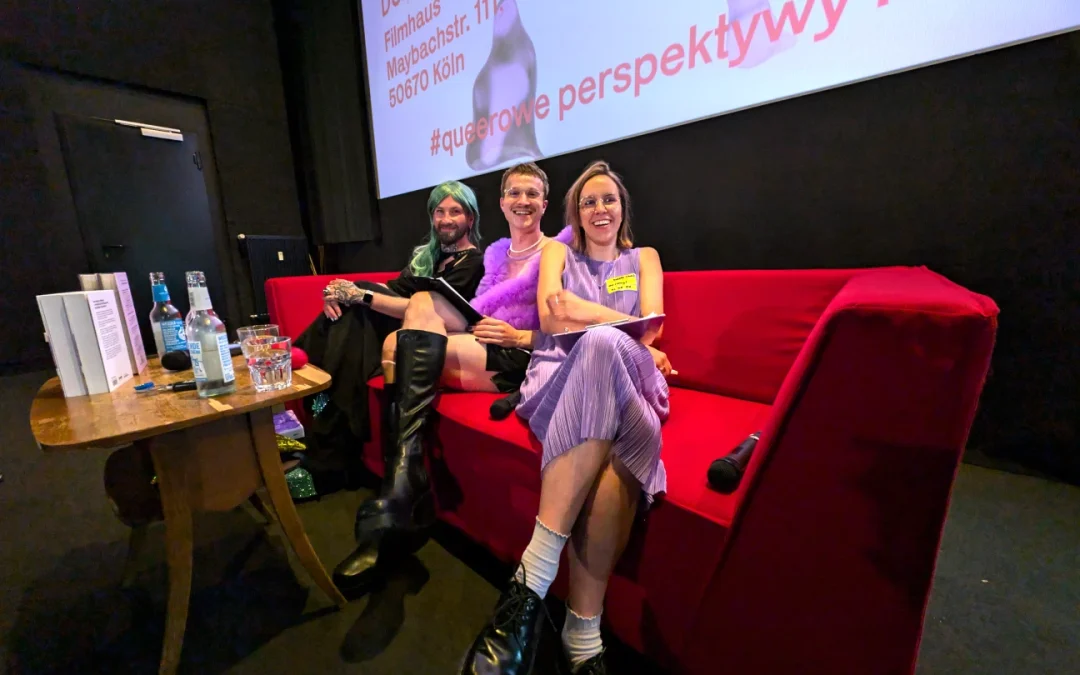
Queerowy Klub works for LGBTQIAP+ people with Polish and migratory experience. Mostly those living in Cologne, but not only. It is the only Polish-diaspora-queer initiative in Germany. Because of that, they are also reached by people from other cities and those just thinking about moving abroad. Their work lies at the crossroads of integration, support, and representation of the queer Polish community. When we touch on the latter, Kol immediately says, “(…) Exactly! That’s what’s very important for us: transculturality, building a bridge between Germany and Poland. And showing, in an intersectional way, that the Polish community in Cologne, quite large by the way, also includes LGBTQIAP+ people, with different stories and Polish roots. Polish queerness in Germany is way more diverse than it seems.”
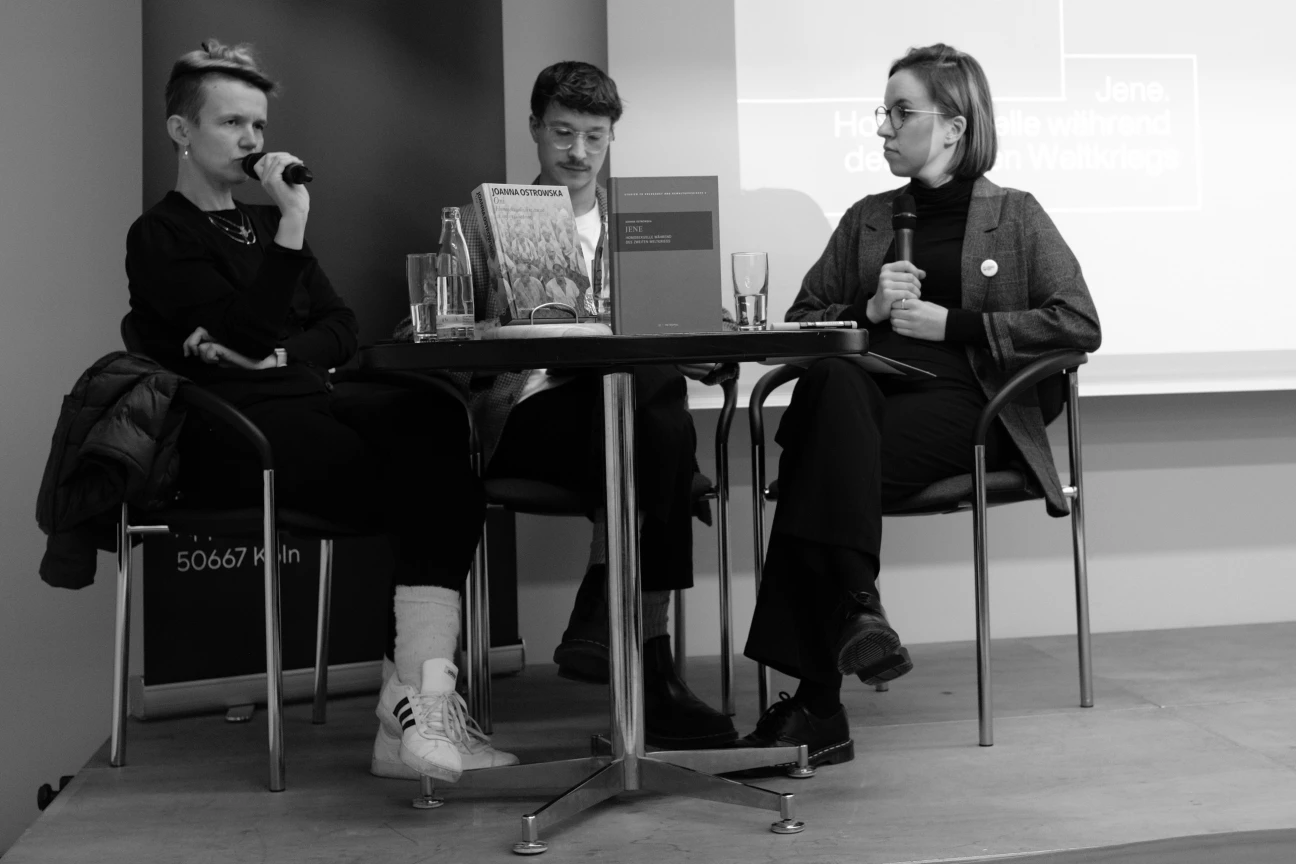
Mateusz adds, “One of the pillars of our work is trying to make queer topics visible within the Polish migrants, to chip away at and move beyond that monolithic narrative about Poles. It’s quite one-dimensional, quite stereotypical – and not just in Germany, I think. We want to prove and show that this perception is wrong, because we are also part of Polish representation, and Poland itself is simply diverse.”
Throughout our conversation, the tension of balancing between Polish identity and the search for belonging in a new community keeps resurfacing.
The topic we discuss connects decades of LGBTQIAP+ migration experiences. In March 2006, the German daily Die Tageszeitung reported on solidarity protests in Berlin against the homophobic policies of then-President Lech Kaczyński. According to the article, Germany was already becoming a refuge for Polish gay men and lesbians. At the time, Magdalena Liskowska, a student advisor at Humboldt University, noted that as many as one in three young Poles coming to study Slavic languages openly identified as homosexual. ‘One of the new students came to me and shouted, “Magda, Magda, I can finally say I’m gay!”’ she recalled.
Tomasz Bączkowski, who had lived in Berlin for ten years at the time, also confirmed that the city had become a safe space for the Polish queer community. “It’s mostly young lesbians and gay men from Polish provinces who come to Berlin. Back home, no one knows they’re homosexual. Only here can they openly admit their orientation,” he said.
Bączkowski estimated that 30% of young Poles arriving in Berlin in 2006 were homosexual.
How is it now? Although the last two decades have brought many changes for the LGBTQIAP+ community, some of Mateusz’s and Kol’s stories echo those of people who emigrated years ago. Recalling the beginnings of Queerowy Klub, Mateusz talks about the distance Polish people sometimes feel toward getting involved. “In our conversations, the theme of being alienated kept coming up. A lot of people don’t identify with that version of Polishness that’s homophobic, right-wing, or very conservative. Often these are people with painful experiences from Poland – one of the main reasons they left. Some even avoid Polishness altogether, because it feels unpleasantly charged.”
Kol adds, “For me, the need to be with people from Poland only appeared after about seven years of living in Germany. When I first moved, I had no desire at all to engage with the Polish community. Because of my experiences in Poland, I completely suppressed my Polishness, and only recently have I started to rediscover it and acknowledge that it’s part of me.”
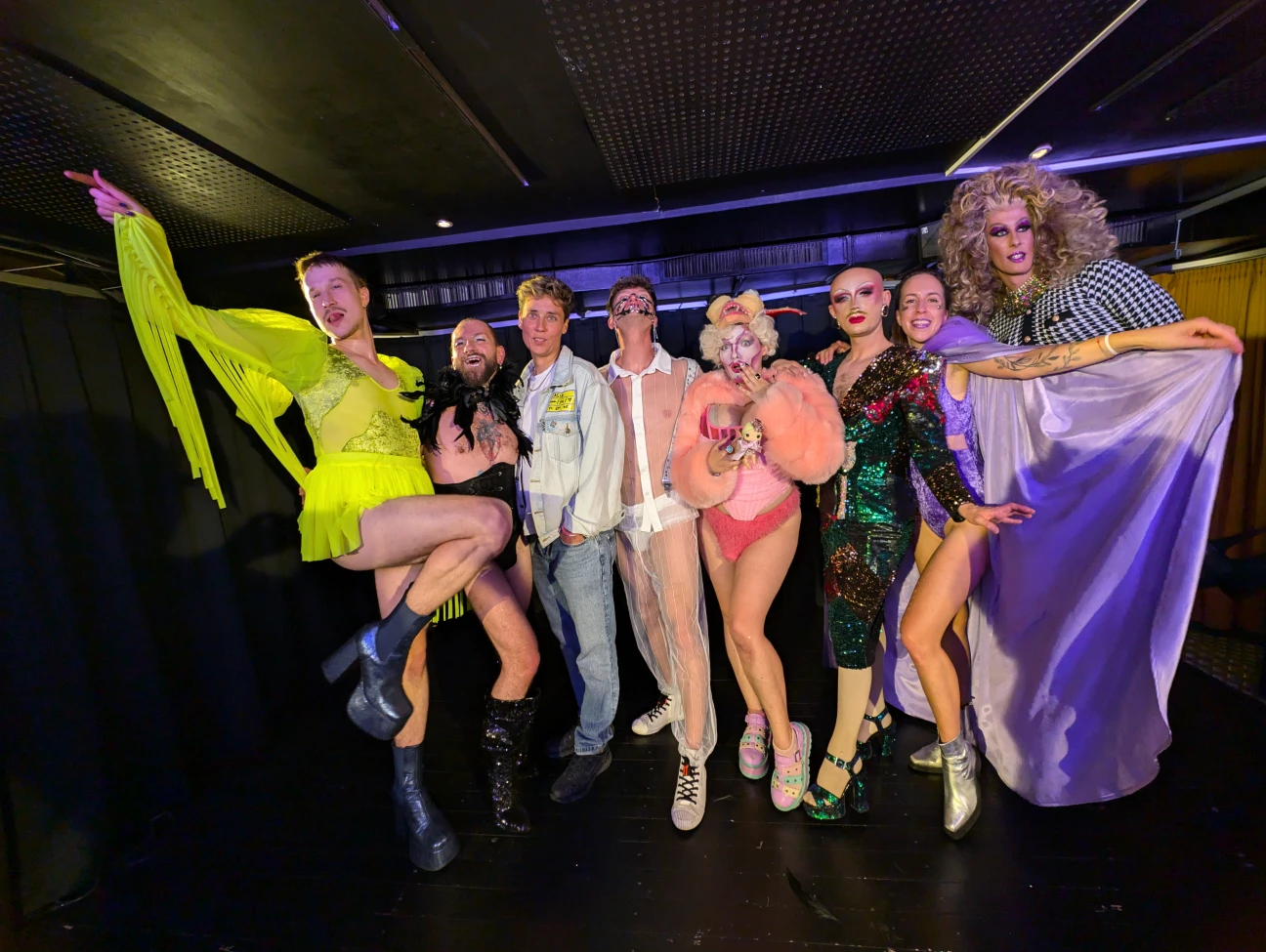
Despite the difficulties of navigating complex identities – Polish, migrant, queer – our conversation carries a tone of joy in creating and participating in community. As Mateusz says, “It’s a personal need for me, but I hear many similar voices. They often come up after events – a literary meeting, a drag show, a film screening. These aren’t just cultural events. We always encourage people to stay afterward, to share the experience of being here together. And that’s when we hear things like, ‘Thank you for existing, for doing this, it matters.’ For each person it’s a bit different, but there’s a shared need to build togetherness.”
That same longing guided earlier generations of migrants who tried to rebuild bonds and communities in new places. While preparing for my interview with Mateusz and Kol, I found a box in the archive of Berlin’s Schwules Museum – filled with press clippings, notes, and photographs documenting Polish-German collaborations and events. Since the late 1980s, the Polish migrant queer diaspora had been creating a new home here.
Poetry salons, art exhibitions, discussion panels, and academic readings about the situation of LGBTQIAP+ people in Poland intertwined with solidarity protests against consecutive governments and their homophobic policies – the same ones driving new generations to leave.
As Mateusz recalls, “After the pandemic, even before Queerowy Klub was founded, there was definitely a wave of people moving from Poland to Germany. That was still during the PiS government. I left Poland myself at that time, because of homophobia. And since we’ve been active, we’ve been contacted by people planning to move for the same reason. (…) You can really notice these waves. The more homophobic or queerphobic the politics get, the more people consider leaving Poland.”
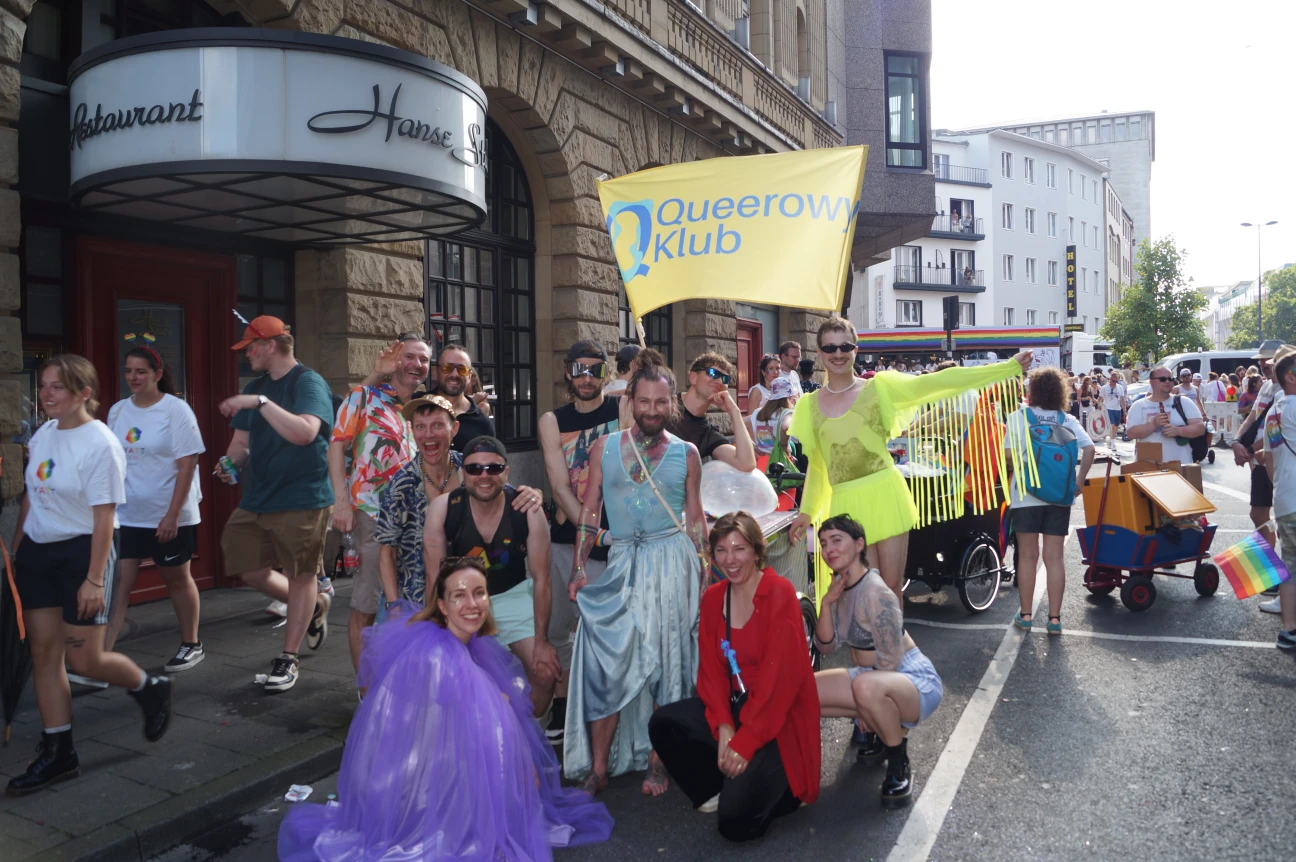
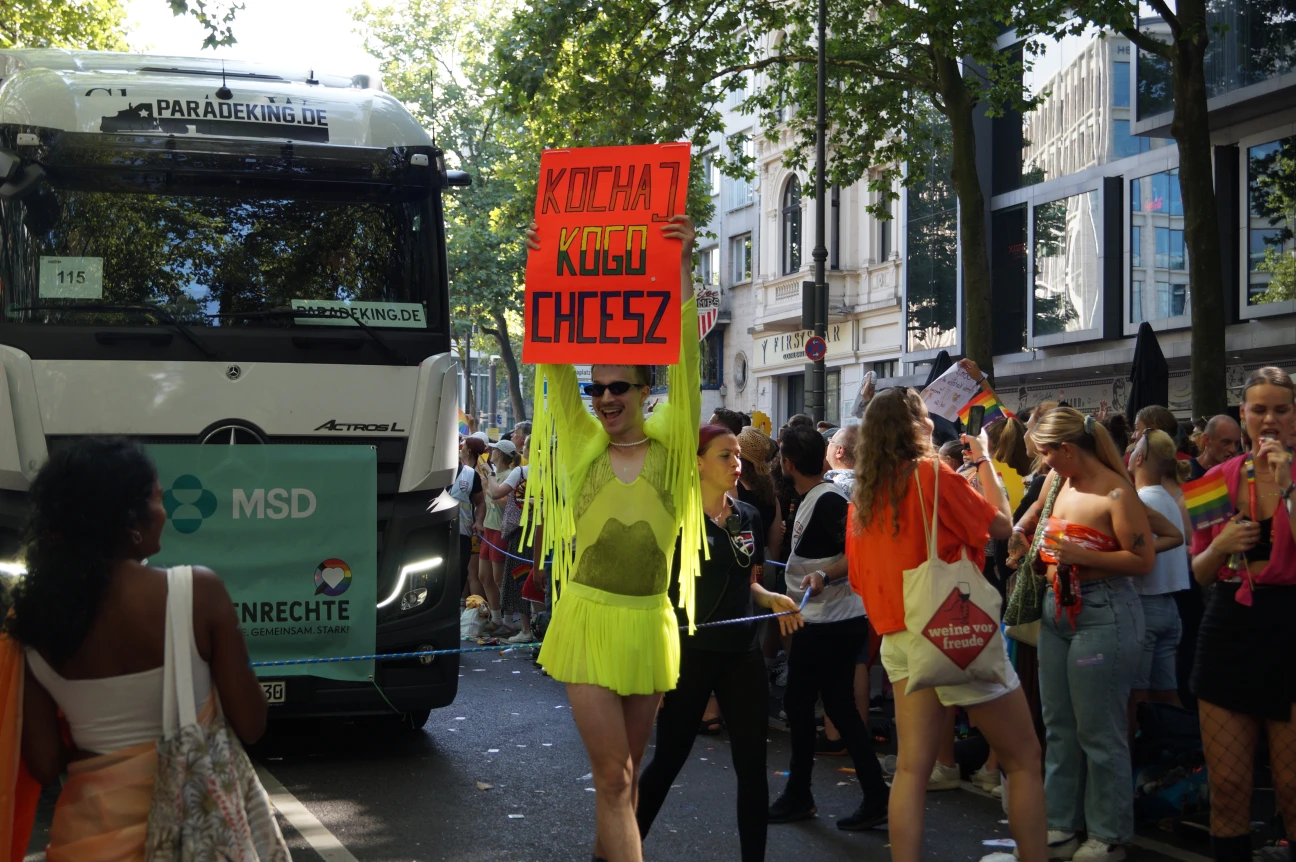
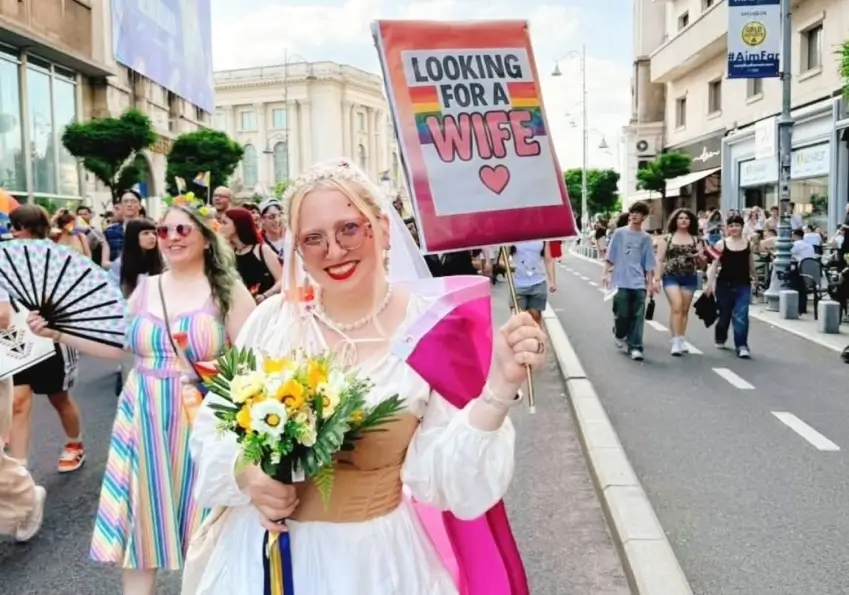
Mateusz and Kol emphasize that being visibly present in the city’s public space is empowering and important – for themselves and others. They show up not only at Cologne Pride, but also at events like Dyke March and Radical Pride – always with Polish banners and slogans. There, they meet many faces of Polishness. People approach them – migrants, queer and not – some are just observing the march, some have Polish roots but don’t speak the language nor have ever even been to Poland. All carrying a good word, hug or simply a greeting.
Queerowy Klub’s mission is not only to build community, but also to support it. When asked about the difficulties LGBTQIAP+ people face after migration, they mention language barriers and trouble accessing medical or therapeutic services offered in Polish that are also inclusive for non-heteronormative and trans people.
They also describe the feeling of being stuck in a limbo, belonging neither to the local queer community nor to the Polish diaspora, especially when the latter takes on conservative forms.
“There’s quite a large group of Poles here who hold very conservative, right-wing views, including homophobic and racist ones. I had a really bad experience myself,” says Mateusz. “It turned out two Polish men were our neighbors, and when they saw the rainbow flag, they tried to set our apartment on fire. To this day, there’s the word ‘faggot’ burned into our door. And that’s when I thought: damn, I left Poland to escape this, and it’s still catching up to me. I had to do something.”
Before founding Queerowy Klub, Mateusz was already active in the migrant community: helping newcomers with paperwork, joining local collectives, and working in election commissions. Although he speaks of difficult experiences, he also highlights the existence of democratic and supportive migrant groups in Cologne. Unfortunately, Polish ones often lack contact with LGBTQIAP+ people and therefore don’t know how to support them effectively. The work of Queerowy Klub is helping to change that. This year, they collaborated with the Polish Community Office, preparing educational materials for Pride Month. They are also supported by the city and district, which invite them to participate in local equality and diversity initiatives.
When asked about their dreams, they shower me with plans. This year, Kol wants to focus on organizing events for FLINTA* people – women, lesbians, intersex, non-binary, trans, and agender individuals. They also hope to involve more people in the day-to-day work of Queerowy Klub, which currently consists of three core members. Mateusz, in turn, wants to formalize the collective as an official migrant organization, so it can be listed in the register and represent the queer Polish community at migrant-dedicated events organized by the Polish Parliament and Senate.
“There have already been three such programs, and among all the Polish migrant organizations worldwide, we were the only ones representing LGBTQIAP+ people. That’s why visibility is so important to us – it’s political. We need to be in the statistics and the registers, so that our work is visible from Poland’s perspective,” they explain.
They also dream of having their own space. As Mateusz says, “A place you can always come to.” Because Queerowy Klub is not just an organization – it’s an attempt to create a home, where once they had to imagine one from scratch.
Read more articles from the Issue
Nothing Found
Criminalized and Invisible: The Long Fight of Queer Ukrainians
Conversion Practices in Germany: Violence in the Name of God
Valentyna Salon: Beauty Practices of the Ukrainian Queer Community
“There is a lot of shame in our community”
How Ukraine’s Queer Artists and Activists are Safeguarding LGBTQIA+ Memory in Wartime

Eastern Queerope Belarus: Stories of Resistance, Repression, and Cultural Renewal

Homophobia at the Core of Putinism’s Ideology
Strange Embrace: Paradoxes of Homosexual Desire in the Third Reich
Beauty as a Shelter: Ukrainian Women Rebuild Their Lives in Bucharest’s Salons

Angels from the East

Passing the Paintbrush: Historic Queer Jewish Artists in Berlin
Searching for Oneself at Random: How LGBTQI+ Communities Emerged in the Donetsk Region, 1991-2014

“I Have Nothing to Hide”

When We Stopped Hating Ourselves: Gay Life Under Persecution In Poland And Germany

How Queer Soldiers Shape Ukraine’s Defense And Future

Unsafe in The Country of Origin

The Bible, Putin, AfD: Four Misanthropic Myths to Abandon

Queer Resistance in Ukraine: Between War and Disinformation

No Safe Place
19th Century ‘Friendships’ to 90s Drag: Eastern Queerope Returns

Asylum Discourse: What Are “Safe” Countries of Origin for Queers?
Queer Fronts
Moving Stories: LGBTQIA+ Ukrainian Refugees
Beyond the Binary
Queer Rights and Marriage Equality Under War, Authoritarianism, and Democracy
Gaps in Remembrance – Queer Biographies during National Socialism
Queer and Trans People Have Always Been Here. These Are Their Stories
New Stories from Eastern Queerope
The Prisoners with the Pink Triangle
Queerly Beloved: Romani Resistance Through the Ages
Intertwined Queer Stories: First LGBTIQ+ Museum in Eastern Europe
“The Smaller the Settlement, the Greater the Influence of Religion”: Belarusian Trans Non-Binary Activist in Poland
Queer Holocaust Voices – the Price of Silence

Forgotten Stories of Eastern European Queer Heroes
“I Accept Myself with All My Features”: Ukrainian Queer Person and Her Identity in Catholic Poland
Belarusian on Bisexuality, Theatre and Emigration
Shelters, Help and Support: How Uzhhorod Became a New Home for Queer People
Diversity in Brandenburg: Queers Take a Stand
Being Yourself. How Kharkiv’s LGBTQI Community Fights for Their Rights